


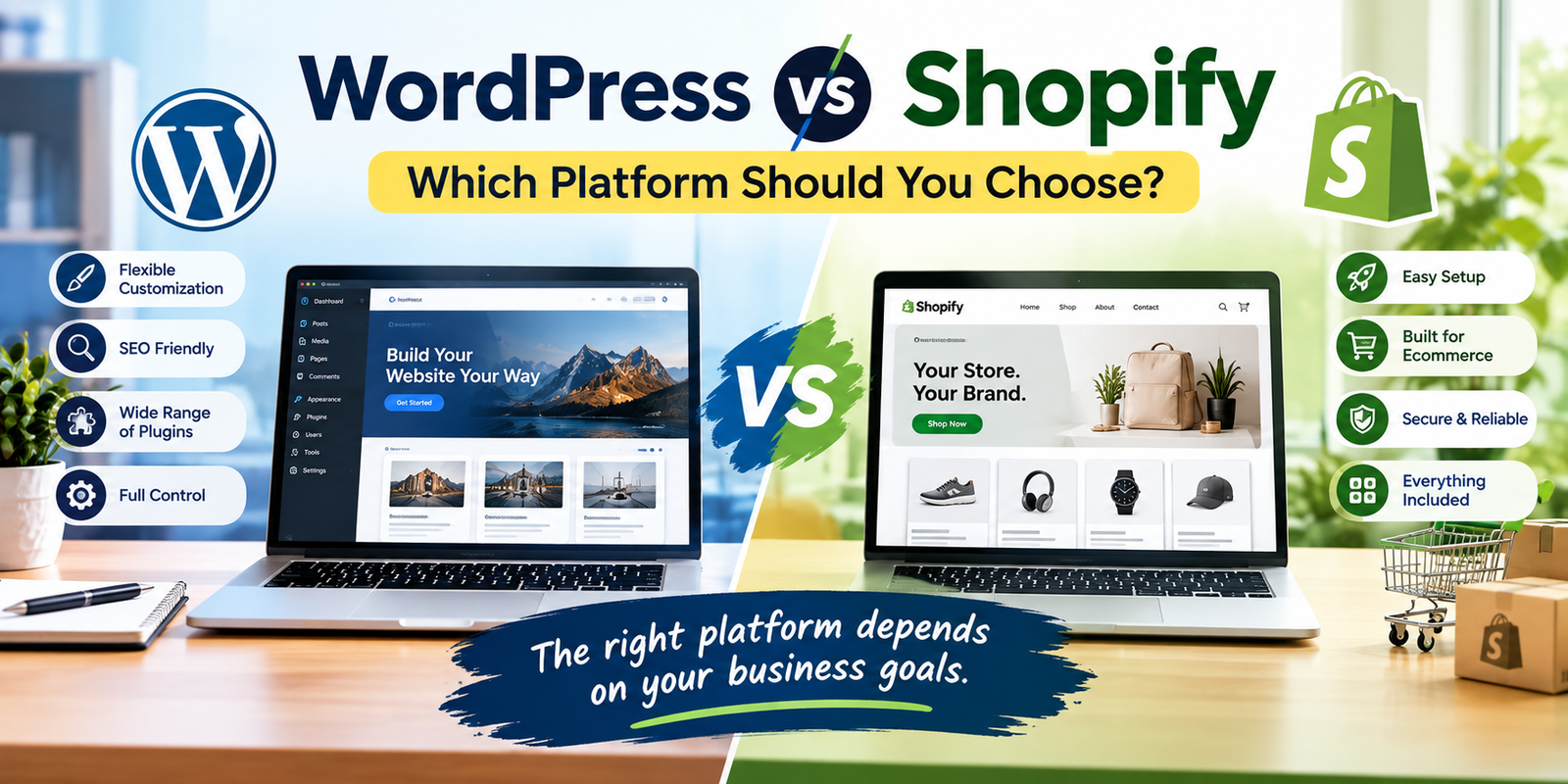
Choosing the right platform for an online business is an important decision. For many U.S. businesses, the choice often comes down to two popular options: WordPress and Shopify.
Both platforms can help businesses build a professional online presence and sell products online, but they are designed around different approaches.
Shopify focuses primarily on making eCommerce easier to launch and manage, while WordPress offers greater flexibility and control through its extensive ecosystem, particularly when combined with WooCommerce.
So, which platform is best for U.S. businesses in 2026? The answer depends on your business model, budget, technical requirements, growth plans, marketing strategy, and the level of control you want over your website.
In this guide, we'll compare WordPress vs Shopify across design, eCommerce, SEO, performance, security, costs, scalability, integrations, maintenance, and more.
WordPress is a content management system that can be used to create websites ranging from small business websites and blogs to large eCommerce platforms.
For online stores, WordPress is commonly paired with WooCommerce, which adds eCommerce functionality such as:
One of WordPress's biggest advantages is flexibility.
Businesses can customize almost every part of their website, from the design and content structure to functionality and integrations. For U.S. businesses that want complete control over their website, WordPress can be a powerful choice.
Shopify is an eCommerce platform designed to make it easier for businesses to launch and operate online stores.
Unlike self-hosted WordPress, Shopify provides much of the technical infrastructure needed to operate an online store.
This can include:
For a U.S. entrepreneur who wants to launch an online store without managing complicated technical infrastructure, Shopify can be an attractive option.
One of the biggest differences between the two platforms is how much technical responsibility the business owner wants to handle.
Shopify is generally easier for beginners.
A business owner can create an account, choose a theme, add products, configure store settings, and begin selling without having to manage a separate hosting environment.
A business owner can create an account, choose a theme, add products, configure store settings, and begin selling without having to manage a separate hosting environment.
This makes Shopify particularly attractive for:
WordPress gives users significantly more control, but that flexibility can introduce additional complexity.
Businesses may need to manage:
A professional WordPress developer or agency can handle these responsibilities, but businesses should consider them when comparing platforms.
A startup should consider its immediate needs and future plans.
If the startup is launching a product-based business and needs an online store quickly, Shopify can reduce the technical workload.
If the startup is building a unique digital product, marketplace, membership platform, community, SaaS-related website, or complex customer experience, WordPress—or even a fully custom application—may be more appropriate.
The best platform is the one that supports the startup's business model without creating unnecessary limitations.
There is no universal winner.
Choose Shopify if:
You want a streamlined eCommerce platform that allows you to launch and manage an online store with less technical responsibility.
Choose WordPress if:
You want greater control, extensive customization, powerful content capabilities, and flexibility for complex business requirements.
Consider custom development if:
Your business requires functionality that standard platforms cannot provide efficiently.
